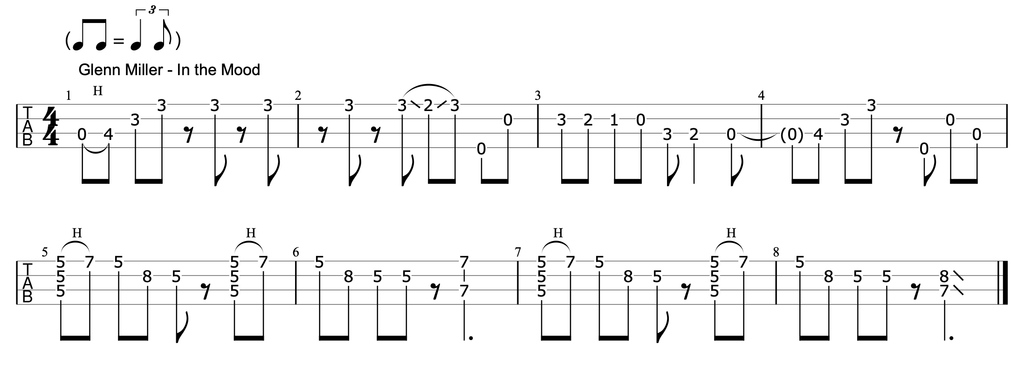
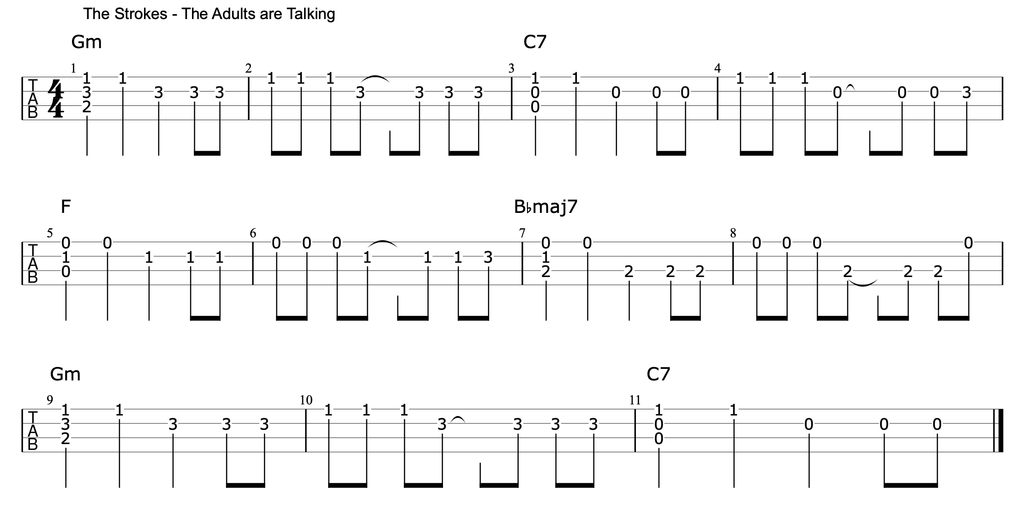
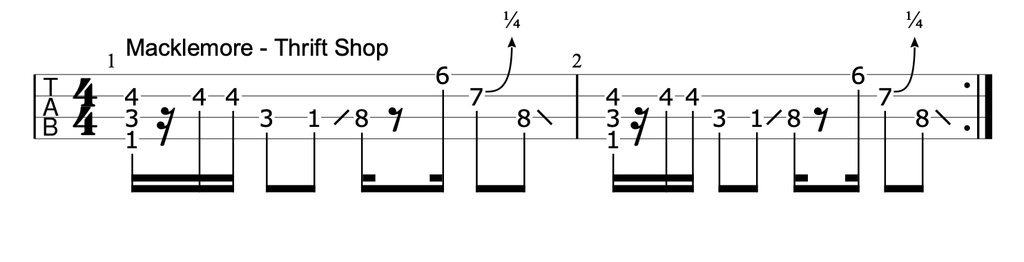
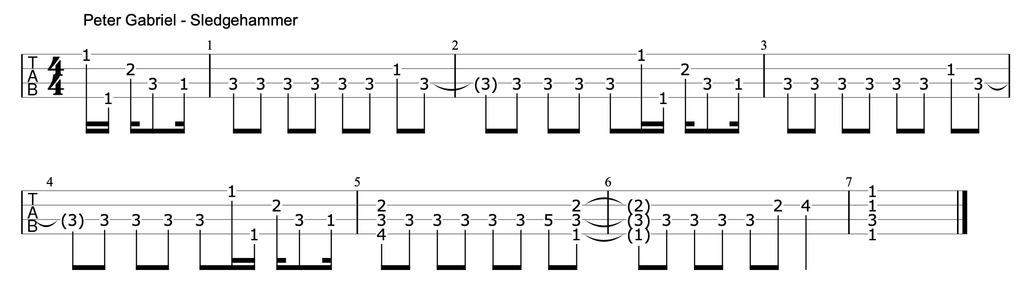
Verse: The verses, being in C major, are fairly straightforward to play.
The third verse starts off mimicking the recorder solo. So there are more strums and the melody is stiffer. And there are a few variations in the second half of the verse to watch for.
Chorus: The song switches to C minor for the chorus. Which makes things more of a challenge. But if you’ve got your barre chords down, it’s not going to be much of a problem.
Intro: Like the rest of the song, the intro is challenging but fun to play. The biggest challenge is playing it at tempo. So I recommend getting it under your fingers at a low tempo before you try to speed it up.
The first four bars of the intro are picked with thumb and two fingers. Then it switches to one-finger-per-string for the final four bars.
Chorus: The picking here is more chaotic. It’s mostly strummed with the single notes played by whatever finger comes to hand.
Verse: Back to thumb and two finger picking for the first four bars. After that, there’s some very rapid notes. So you’ll need to alternate between thumb and middle finger to pick those.
Intro: I played this section across the strings rather than up and down them. Here’s a more straightforward version:
I also went with the traditional finger clicks. But playing muted strums works too and is easier.
Chorus: The chorus is more bouncy and playful than it is mysterious and spooky. Lots of slides and pull-offs to navigate. It’s a little tricky but lots of fun once it’s under your fingers.
Steppenwolf’s Born to be Wild is a real basher. It’s one of the rare occasions where the video is my first take. It’s not the cleanest, but it had the most energy. And that’s the most important thing to get in this song.
Intro: This is all strumming away on a C5 chord until the last bar where I throw in a little lick inspired by the bass part.
Verse: Still hammering away on that C5 chord.
Chorus: We finally get a couple more chords. So there’s a slight increase in difficulty. There’s a stretch for the fifth fret in bar 13. Otherwise, it’s clear sailing.
Bridge: The bridge section gets sparse. So I was tempted to throw in some muted strums in bar 28 and build up into the “Borrrrrrn to be wiiiiiiieiiiild” section. So give that a try and see how it feels.
Solo: This solo doesn’t match the original in anything more than vibe. So feel free to change it however you like. Any sort of widdling on the C minor pentatonic scale will work.
Intro: It’s odd to hear a harpsichord on a Motown record. The song was recorded in Motown’s “Hitsville West” in LA rather than Detroit. So perhaps they were influenced by the scene that produced songs like Monday, Monday and When I Grow Up.
Verse: Nothing too difficult in the first verse. The only tricky bit is a quick flourish on the melody in bar 8. Which you can drop altogether if you don’t fancy it.
The second verse brings in some noodling higher up the fretboard that requires some fast shifting.
This section has my favourite part of the song: the tasty C7sus4 in bar 10.
Chorus: The chorus modulates from the key of F to Ab. This much less uke-friendly key does present some challenges. Particularly some awkward finger-shuffling between bars 15 and 16.
Outro: Probably the trickiest part of the song with the most shifting up and down the fretboard.
Verse: There are two halves to the verse. The first half is loose and rhythmically varied. You can be very expressive in your playing here.
The second half is much more structured. You have a repeated rising pattern of eighth notes. But you can still get some emotion in through dynamics. I like to increase the volume through the pattern.
Pre-Chorus: My favourite section to play. Both the loud first pre-chorus and the quiet second one.
Chorus: Lots of rapid picking here that you’re going to need to use alternate picking to play (i.e. alternating between picking with your index and middle fingers).
Solo: By far the most difficult section to play. I switch to strict thumb and two-finger picking for this section. It’s played fast and you have to be quick with the chord changes.
If you don’t fancy it, I think you can skip it and no one will care. You could also come up with your own section here using the same chords.
Bridge: The melody here is almost the same as the verse but played over a different chord progression.
Intro: This sets up the chord progression that’s used for the whole song except the solo. The main feature is the descending line that moves down from C down to G#.
Verse: The verse is very loose and a little tricky on the uke since the melody notes sometimes conflict with that descending note in the chords.
Chorus: The chorus, on the other hand, works perfectly on the uke. To give the melody extra inflection, there are a few slides and hammered-on grace notes (e.g. bars 14 and 16).
Solo: The solo is completely different from the rest of the song. It’s in a different key and the chords don’t have that simple connection between them. But, as solos go, it’s fairly easy to play.